

Seeing your child still complain of pain several weeks after surgery can be worrying. You may have expected a “keyhole” operation to mean a quick recovery. If you are searching for pain 4 weeks after laparoscopy, the key question is not only how many days have passed, but whether the pain is steadily improving.
Recovery after pediatric laparoscopic surgery varies with the child and the procedure. Full recovery can take several weeks, so mild discomfort at four weeks is not automatically abnormal. Pediatric laparoscopic guidance notes that complete recovery may take around four to six weeks, depending on the child and the operation performed.
Is Pain 4 Weeks After Laparoscopy Normal in a Child?
Four weeks can still fall within the recovery period for some children. A diagnostic laparoscopy, laparoscopic appendectomy, hernia repair, and a more complex abdominal operation do not all heal at the same speed.
A better way to judge recovery is to look at the pain trend. Mild soreness that becomes less frequent or less intense is more reassuring than pain that stays strong, returns after improving, or gets worse.
Think of four weeks as a recovery checkpoint, not a fixed deadline. Increasing pain after surgery is one reason to contact the child’s healthcare provider rather than simply waiting for more time to pass.
Why Might a Child Still Have Pain After 4 Weeks?
Small incisions can look healed while tissues involved in the operation are still recovering. Some children may also notice tenderness as they become more active again. Walking more, returning to school, or moving normally can put new strain on areas that are still healing.
The operation itself matters. After a laparoscopic appendectomy, for example, complete internal healing may take several weeks even when the child looks much better from the outside.
Parents sometimes blame pain weeks later on the gas used during laparoscopy. Carbon dioxide is commonly used during the operation to create working space inside the abdomen. However, shoulder discomfort from this gas is usually an early postoperative issue that resolves on its own. A study in children undergoing laparoscopic appendectomy found this gas-related shoulder discomfort was most common on the first day after surgery, became less common over the next two days, and was uncommon by the fourth day.
What Does the Pain Pattern Tell You?
Instead of focusing only on a pain score, look at how the pain is changing. A simple five-part check can help you give your child’s surgeon clearer information:
- Intensity: How strong is the pain?
- Trend: Is it better, unchanged, or worse than last week?
- Location: Is it near an incision, in the belly, or somewhere else?
- Other symptoms: Is there fever, vomiting, swelling, or a wound change?
- Activity: Is pain affecting eating, walking, sleeping, school, or play?
This is not a home diagnostic test. It is simply a practical way to track recovery and explain what has changed.
Which Pain Patterns Are More Reassuring or Concerning?
Some recovery patterns are more reassuring because they show that the child is gradually moving forward.
More Reassuring Patterns
- Discomfort is slowly easing
- Your child is becoming more active
- Eating and drinking are normal
- Incisions continue to heal
- Pain is less frequent than it was before
Patterns That Need Medical Review
- Pain is becoming stronger
- Your child is becoming less active
- Fever or repeated vomiting develops
- The abdomen becomes increasingly swollen
- An incision becomes red, swollen, opens, bleeds, or has discharge
These signs do not automatically mean that a complication has occurred, but they should not be ignored. Pediatric postoperative guidance lists increasing pain, vomiting, fever, swelling, and wound changes among reasons to contact a healthcare provider.
When Should Parents Contact the Pediatric Surgeon?
Contact the surgical team if pain is not improving as expected or worsens. You should also seek medical advice if your child develops:
- Increasing or severe abdominal pain
- Fever
- Repeated vomiting
- Increasing abdominal swelling
- Redness or swelling around an incision
- Bleeding or unusual wound discharge
- Difficulty passing urine
General laparoscopy guidance also identifies fever, wound redness or swelling, abnormal discharge, vomiting, and urinary problems as reasons to contact a healthcare provider.
Severe or rapidly worsening symptoms should be assessed promptly rather than waiting for the next routine appointment.
Does Recovery Depend on the Type of Laparoscopic Surgery?
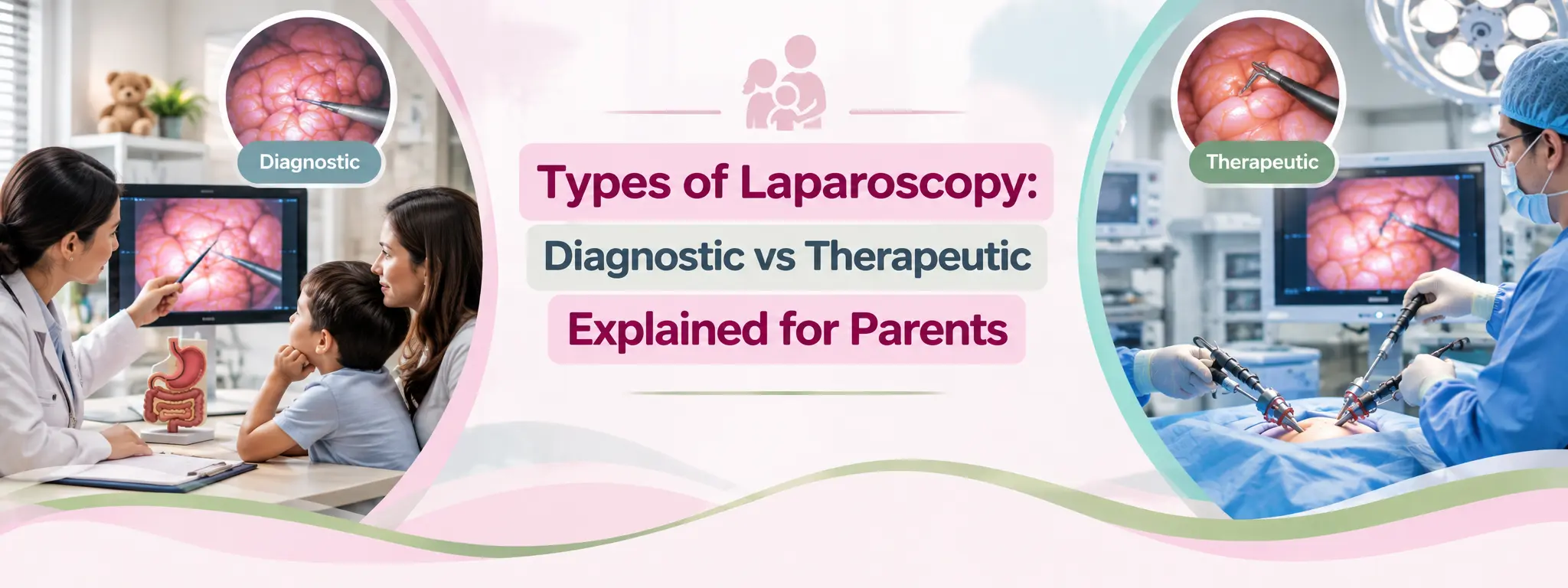
Yes. Laparoscopy describes a minimally invasive way of operating; it is not one single operation. It may be used to examine the abdomen, remove an appendix, repair a hernia, or treat another condition.
This is why two children who both had “laparoscopy” can have different recovery timelines. Pediatric guidance suggests full recovery may take four to six weeks, depending on the child and the exact procedure.
Your child’s surgeon’s discharge instructions are therefore more useful than a general online recovery timeline.
What Should Parents Do If Pain Is Still Present?
If pain continues at four weeks, avoid guessing the cause. Instead, collect useful details for the surgical team:
- Note exactly where your child feels pain.
- Compare the pain with the previous week.
- Notice which movements or activities bring it on.
- Check for fever, vomiting, swelling, or changes to the wound.
- Follow the medicine and activity instructions given after surgery.
Do not restart strenuous sports or heavy activity simply because four weeks have passed. Timing depends on the procedure performed, the child’s recovery, and the surgeon’s advice.
FAQs
Should my child be completely pain-free after four weeks?
Not always. Some children may still have mild discomfort while recovery continues. What matters is whether the discomfort is becoming less noticeable rather than stronger.
Can my child return to sports if some pain remains?
Do not decide by time alone. Restart vigorous activity according to the procedure, recovery progress, and your child’s surgeon’s advice.
Why does my child hurt even though the cuts look healed?
Skin incisions can look healed before all tissues involved in surgery have fully recovered. Discuss persistent or worsening pain with the surgical team.
Should we wait until the next follow-up appointment?
If pain is worsening, not improving, or occurs with fever, vomiting, increasing swelling, or wound changes, contact the surgical team rather than waiting for a routine visit.
Conclusion
Parents do not need to work out the cause of postoperative pain at home. What helps most is noticing whether recovery is moving forward and explaining any changes clearly.
If your child’s pain is persistent, worsening, or concerning, speak with the pediatric surgeon who knows the exact procedure performed. Families in Amritsar can also seek pediatric surgical guidance from Child Surgeons, led by pediatric surgeon Dr. Harparkash Singh Miglani.